

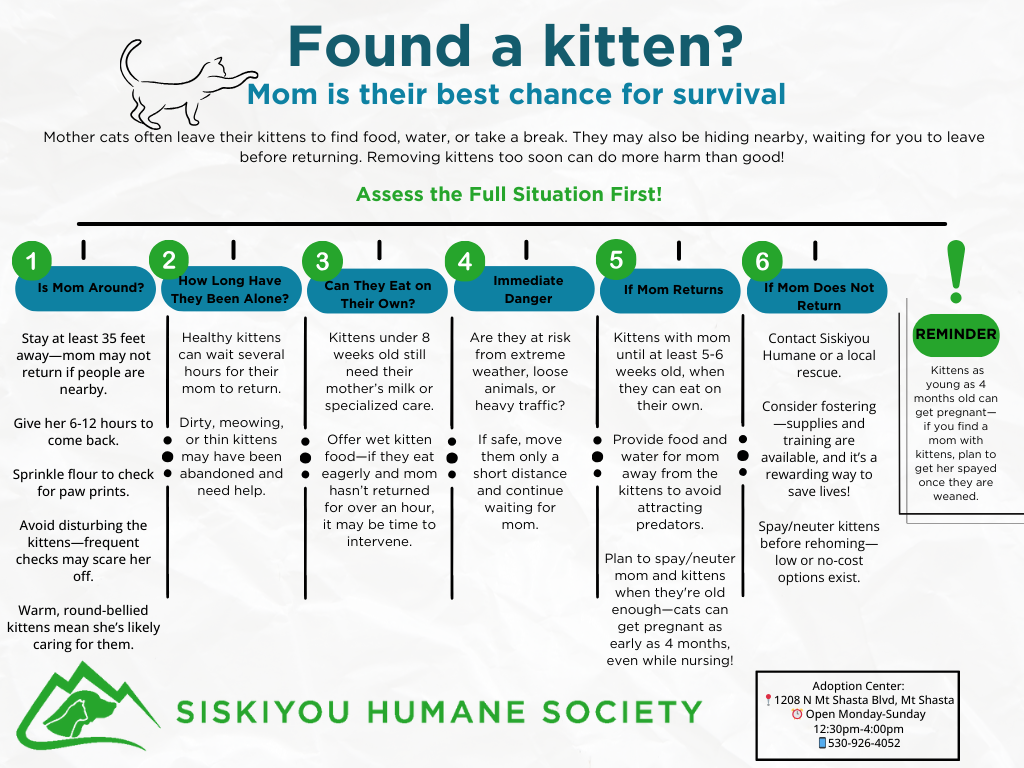
What to Do If You Find Kittens
1. First: Wait and Watch
During spring and summer, mother cats often leave kittens alone while they look for food or move them. Before assuming they’re abandoned:
- Stand at least 35 feet away so mom feels safe returning.
- It may take several hours for her to come back.
- Only intervene if the kittens are in immediate danger (weather, traffic, predators, harmful people).
Healthy kittens can go hours without food as long as they stay warm. A mother cat is always their best chance of survival.
2. If the Mother Returns
If mom is feral and the area is safe:
- Leave the family together until kittens are 4–5 weeks old (when they start eating on their own).
- You may offer shelter and food, but keep them separate so mom doesn’t feel her nest is threatened.
- Do not try to confine a feral mother cat.
If you plan to socialize the kittens:
Bring them inside around 4–5 weeks old, handle them often, and have them spayed/neutered around 8–10 weeks.
If you cannot foster:
Leave the kittens with mom so they can learn survival skills. Do not socialize kittens you can’t place.
Remember: mother cats can get pregnant again while nursing. Contact Purr Angels (530-842-1875) for help spaying feral cats.
3. If the Mother Does NOT Return
If mom is confirmed gone (injured, deceased, or clearly not returning):
You may take the kittens in—but be prepared for a major commitment. Newborns need round‑the‑clock care every 2–3 hours.
- Most shelters and vets cannot take newborns on short notice.
- The Siskiyou Humane Society may help find a bottle-feeder, but it can take days or weeks.
Contact: 530‑926‑4052.
SHS can support finders willing to foster with food, supplies, and medical care until kittens are 8 weeks and 2.5+ lbs.
If you choose to raise them yourself, you’ll be responsible for:
- vet care
- spay/neuter
- vaccinations
- finding homes
Spay/neuter assistance is available—please help stop the cycle of more litters.
4. How to Estimate Kitten Age
- Under 1 week: Eyes closed, ears flat, pink skin, may have umbilical cord.
- 1–10 days: Eyes starting to open; still tiny.
- 3 weeks: Eyes open, ears up, teeth showing, wobbly walking.
- 4–5 weeks: Eye color changing, more active, starting to eat soft food.
Age guide: http://aspcapro.org/blog/2014/07/03/tip-week-4-ways-tell-kittens-age
5. Basic Kitten Care & Bottle‑Feeding
Warmth first — ALWAYS.
Never feed a cold kitten. Warm them slowly using a towel and your body heat.
Feeding:
- Kittens under 4 weeks need bottle-feeding only.
- They cannot pee/poop on their own—stimulate them after every feeding.
- Feed every 3 hours (or every 2 hours for tiny/sick kittens).
Use only kitten milk replacer — NOT cow’s milk, goat’s milk, or human formula.
Recommended powdered formulas include KMR or Just Born.
Once opened, formula must be refrigerated.
6. Need Help?
- Siskiyou Humane Society advice line: 530‑926‑4052
- Foster program inquiries: same number, ask for the coordinator or manager
- Kitten socialization tips: https://www.alleycat.org/community-cat-care/kitten-socialization-how-to/